AIWriteBook Review: A Closer Look at Its Features and What It Can Do
Writing a book sounds romantic until you actually sit down to write one.
At first, you have the idea, the excitement, maybe even a few pages of notes. Then comes the harder part: organizing chapters, keeping the story consistent, developing characters, rewriting awkward sections, and somehow turning scattered thoughts into a complete manuscript.
This is where AIWriteBook enters the picture.
AIWriteBook is an AI-powered platform designed to help writers move from a basic concept to a finished book. Rather than treating book creation as nothing more than generating one paragraph after another, the platform focuses on the broader writing process, including planning, drafting, editing, visual content, and book preparation.
But what exactly does it offer? And how does it fit into the workflow of someone who genuinely wants to write a book?
Let’s take a closer look.
What Is AIWriteBook?
AIWriteBook is built around a fairly simple idea: writing a book should not require juggling half a dozen different applications.
Imagine you’re writing a nonfiction book about personal productivity. You might normally use one tool to brainstorm ideas, another to create an outline, a document editor for writing, an image generator for illustrations, and yet another service to prepare the final ebook.
That can become messy surprisingly quickly.
AIWriteBook attempts to bring many of these tasks into one environment. You can start with an idea, develop the structure of the book, work through individual chapters, and eventually prepare the finished manuscript for publication.
It is particularly interesting for writers who know what they want to say but struggle with the blank-page problem.
You don’t necessarily need to arrive with a perfectly formed manuscript. A rough concept can be the starting point.
Book Planning and Outlining
One of the most useful aspects of AIWriteBook is its focus on planning before writing.
That’s important because a book isn’t simply a collection of good paragraphs. It needs direction.
For example, suppose you’re planning a guide called The Beginner’s Guide to Remote Work. You might have dozens of ideas floating around: choosing a workspace, managing meetings, avoiding distractions, communicating with colleagues, and maintaining a healthy routine.
Instead of dumping all those ideas into a document and hoping they eventually make sense, AIWriteBook can help organize them into a more coherent book structure.
The same principle works for fiction.
A novelist may begin with a protagonist, a setting, and a rough conflict but have no idea how to divide the story into meaningful chapters. AI-assisted outlining can provide a framework that the writer can then reshape.
Think of it as a blueprint. You still build the house, but you don’t have to draw every line from scratch.
AI-Assisted Chapter Writing
Once the structure is in place, AIWriteBook can help generate book content.
This is where the platform becomes particularly useful for long-form projects. Instead of asking an AI tool to simply “write a book” in one enormous prompt, the writing process can be approached chapter by chapter.
That distinction matters.
A good book needs breathing room. One chapter might introduce an idea, another might explain it through examples, while a later chapter brings everything together. Breaking the project into manageable sections gives the writer more opportunities to review, adjust, and guide the direction.
For instance, if you’re writing a business book, you might have a chapter about customer retention. You can establish the main argument, provide examples, explain common mistakes, and then move naturally toward practical recommendations.
The AI becomes more like a writing assistant sitting beside you rather than a machine that disappears into the background and returns with an entire manuscript you barely recognize.
Of course, the writer still needs to review the output carefully. AI can produce fluent text, but fluency isn’t the same thing as insight. Your experience, opinions, research, and editorial judgment are what give a book its identity.
Maintaining Style and Voice
Here’s an interesting part of the platform: AIWriteBook is designed to work with a writer’s preferred style and voice.
That’s valuable because one of the biggest complaints about AI-generated writing is that it can sound strangely uniform.
You know the feeling. Every paragraph is polished. Every sentence is perfectly balanced. And somehow, after three pages, it starts sounding like it was written by the same invisible committee.
A personal writing style can make a huge difference.
If you’re creating an educational book, for example, you may prefer a friendly and conversational voice. A business author might want something authoritative but approachable. A novelist may need a darker, more atmospheric tone.
The ability to guide the AI toward a particular voice can help make the generated material feel more aligned with the rest of the manuscript.
Character and Story Development
For fiction writers, long-form consistency is a major challenge.
A character introduced as shy in chapter two shouldn’t suddenly behave like an outspoken social butterfly in chapter fifteen without a convincing reason.
Similarly, plot details, relationships, locations, and timelines need to remain coherent as the story develops.
AIWriteBook is designed to support this kind of long-form continuity by keeping important book information within the writing environment.
Imagine you’re writing a mystery novel with eight major characters, several locations, and a series of clues that gradually reveal the culprit. Keeping track of everything manually can become a headache.
Having the relevant story information organized alongside the writing process can make the task considerably easier.
It doesn’t eliminate the need for human oversight, but it can provide a useful safety net.
Illustrations and Book Covers
Books aren’t always about words.
Depending on the project, visuals can play a major role. Children’s books, educational guides, workbooks, journals, and certain nonfiction titles can all benefit from illustrations or other visual elements.
AIWriteBook includes tools for creating visual content, including illustrations and book covers.
This can be helpful when you’re an author rather than a designer.
Picture someone who has spent six months writing a children’s story but has no experience with graphic design. Traditionally, they would need to find a designer or learn a completely different set of software.
With AI-assisted visual creation available within the same book workflow, the barrier becomes considerably smaller.
The same applies to covers. A cover isn’t merely decoration; it is often the first thing a potential reader sees. Having an integrated way to develop one can make the publishing process feel more complete.
Audiobook Creation
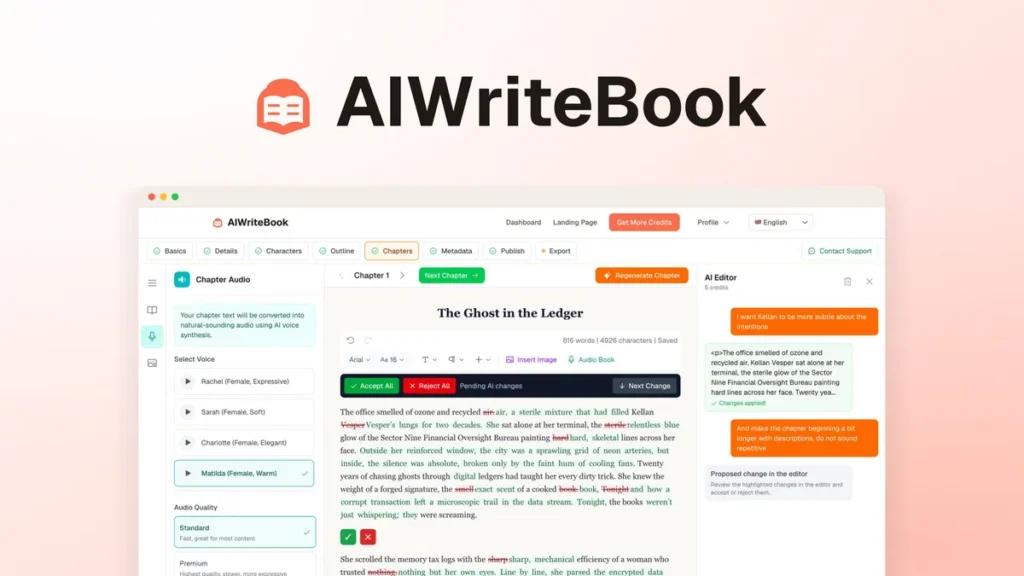
Another feature that makes AIWriteBook stand out is its support for audiobook creation.
Audiobooks have become an increasingly important format for readers who prefer listening while commuting, exercising, cooking, or simply taking a break from screens.
For an independent author, producing an audiobook can feel like another enormous project. Voice recording, editing, and production all require additional time and resources.
AI-powered narration can simplify that part of the process, allowing a written book to be transformed into an audio format without rebuilding the project from the ground up.
For example, an author publishing a practical business guide could potentially offer the same material as a traditional ebook, a printable document, and an audio edition.
One manuscript, multiple ways for readers to consume it.
Exporting and Publishing Your Book
Getting to the final sentence isn’t the end of writing a book.
There’s still formatting, file preparation, and publishing.
AIWriteBook supports common book formats such as EPUB, PDF, and DOCX, making it easier to move the completed manuscript into other publishing or editing workflows.
The platform also provides assistance around publishing preparation, including elements such as book descriptions, keywords, and categories.
That’s useful for independent authors who don’t necessarily have a publishing team behind them.
Think about a first-time author who has written a 200-page guide but has never published anything before. The actual writing may have been the easiest part. Understanding how to package and prepare that book for readers can be much more intimidating.
Having those publishing-related tools connected to the writing process can make the journey feel less fragmented.
AIWriteBook Lifetime Deal by Appsumo
 You signed up to write a book, not format EPUBs, and source cover art after hours. AIWriteBook helps you write voice-matched chapters, design a cover, and export a KDP-ready file. AIWriteBook Appsumo Deal
ONE-TIME PURCHASE OF $79 $144
Alternative to: Scrivener
Integrations: Amazon, Browser based, Google, Google Gemini, Stripe
Best for: Authors, Freelancers, Solopreneurs
How To Get an Extra 10% Discount on AIWriteBook?
- Visit the “AIWriteBook Lifetime AppSumo Deal” page.
- Wait for some seconds, An Discount popup will appear.
- Enter your Email to receive the exclusive benefits.
- Check Your Email Inbox For Next Instructions.
- Get a 10% discount at the end.
- Discount valid for new users only.
So if the main price of AIWriteBook is $79, after getting a 10% discount you can buy it for $71 for your Lifetime. hurray !!!

Do you Want 10% Discount On All Appsumo Products?
Click Here To Join On Appsumo Plus !
Final Thoughts on AIWriteBook
So, what is AIWriteBook really trying to accomplish?
At its core, it is more than a simple AI text generator. The platform takes a broader view of book creation, bringing together planning, writing, continuity, visual creation, audio production, and publishing preparation.
That’s probably its most interesting characteristic.
Whether you’re an aspiring novelist with a story stuck in your head, a professional creating a business book, or someone who wants to turn years of knowledge into a practical guide, the biggest challenge is often not having ideas. It’s turning those ideas into something structured and finished.
AIWriteBook aims to make that process more manageable.
Still, it’s worth remembering that AI should be treated as a collaborator, not an autopilot. The strongest results will come from writers who actively guide the process, fact-check important information, revise generated passages, and add their own experiences and perspective.
After all, readers don’t fall in love with a book because an algorithm produced it. They connect with a point of view.
And that’s where the human writer remains at the heart of the process.